
| H.I.J.M.S. Tosa |
|
|
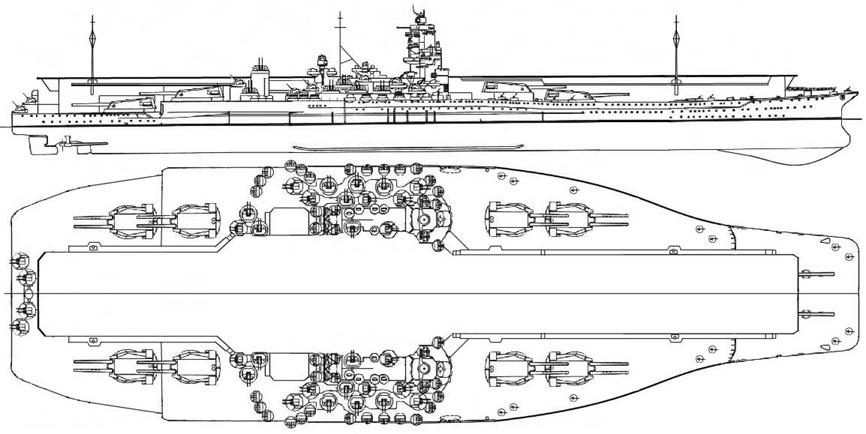
Specifications Ships in class (1) Dimensions: Performance: Armor: Armament: Operation History: Even as a "What-if" ship, the Japanese would never have been crazy enough to build her! Special Notes: The Tosa was seriously considered as a viable building programme in 1939. The concept of having the best of both worlds (fully operation battleship and fully operational fleet carrier) was tempting to many in the Navy. A ship that could bounce bombs and shells, while dealing out damage from its guns and its aircraft, was a tempting prospect. The concept was to build a fortified catamaran hull with propulsion being directed in the tunnel between the two hulls. The carrier flight deck and hanger would be situated as part of the aka: The term "aka" being used lightly as it would be an integrated and armored part of the ship. The obvious benefits of the design would be a very stable platform to operate flights and to fire the battleships principle armament. The screws, shafts and rudders would all be housed in the tunnel, protecting them. The rudder would have been directional vertical vents that would have given the ship a tight turning radius. The exhaust from the turbine and engines would be routed into the tunnel, with auxiliary stacks, hidden in the two bridges, used when the ship was landing aircraft. One major problem was overcome (that would plague the Ise BB/CV hybrids later in the war) by having a complete sets of main armament on each beam and a true full flight deck. The flight deck was heavily armored (much more than any aircraft carrier before it). The two twin bridges were envisioned as allowing both carrier operations and battleship operation simultaneously. The Tosa was estimated to require 3,500 crewmen to operate. The design was ultimately scrapped as no catamaran ship of this size had been attempted. There were major concerns regarding the effect of heavy seas on the lateral integrity of the ship. Flexible joints were proposed for the aka, but the engineers could not allay the concerns of the effects of twisting that may occur on a vessel of the Tosa's size. Another real concern was the effect of a torpedo entering the mouth of the tunnel (a light anti-torpedo grill was planned at the mouth of the tunnel on both ends). Other obvious problems with the design were the size of the target for dive bombers, level bombers and opposing surface vessels. With a beam of 315 feet the ship was three times as wide as most battleships afloat. Although the ship was very heavily armored, the engineers worried about the warping that would be caused by multiple hits and what that would do to the seaworthiness of the vessel. The raw materials needed to build such a ship would have exhausted Japan's already strained resources. Lastly, the principle flaw in the design was tactical: what purpose would there be in a carrier approaching a surface engagement and what purpose would the big guns have if the carrier were operating at a distance from the battle (as carriers were expected to do). The initial naval battles of the opening year (1939-1940) of World War II did much to further convince the Navy that there was no place for the Tosa in modern warfare. The design was modified as the war progressed and was revisited after the carrier losses at Midway. The final design changes were made in 1944 with the addition of two catapults on the bow to launch a compliment of 24 Ohka suicide rockets. The drawing above also shows the originally envisioned 5" D/P twin mounts replaceed by the 3.9" AA twin mounts. If this ship had been built, there is no telling what effect it would have had on the battles it participated in. One can only imagine the effect the Tosa would have had during the Second Naval Battle of Guadalcanal or at Midway. She would have been an mobile island with extensive coastal batteries and a protected airstrip. |