|
The Carrier Escort Aki
The Evolution of a design
The Aki class of pocket battleship / carrier escort ship can be broken
down into three distinct processes with the second and third; and fourth and fifth being split
into slightly modified versions. They will henceforth be labeled Aki101,
Aki102a, Aki102b, Aki103a and Aki103b.
To fully understand the reason for the design of the Aki and her variants
lets first look at her purpose. The Washington and London treaties
stipulated a 10:10:7 ratio of the building of capital ships, with Japan
getting the "short end of the stick", since she didn't have international
interests. This angered the Japanese to no end and, when the Pacific war
broke out, they had fewer capital ships than the British and the Americans.
I always though, "Why didn't the Japanese announce they were building 'Pocket
battleships' like the Germans had to even the score somewhat?" Obviously,
if the Japanese had made this fact public the American and British would have
stepped up their building programs to continue to outpace the Japanese. So,
I devised a way for the Japanese to get around this.
It should first be known that hindsight, of course, has everything to do with
this project and that can't be ignored. The Ise and Fuso class ships were slow
and ended up not participating much in the war because of this. I deduced that
the Japanese could announce that they were modernizing the four oldest
battleships by stripping all four of their two mid turrets and increasing their
horsepower by placing more machinery in the space freed up. They could then
announce that they were building two or three "Aki" class ships and they would
still be even. For although they would have three new "capital ship" hulls in
the water the Japanese 14" turret count would remain unchanged; a loophole in the
treaties if you will.
So the Japanese get four old battlewagons much more fit to fight in a modern war
and two new smaller ships. The purpose of the Aki class was to allow the Kongo
class (who were normally tied to the Aircraft Carriers during the war) to operate
with the other full size capital ships. The Aki class would be the Carrier
escorts, the Japanese could pull them for surface engagements since, although
more lightly armed than the Kongo class, and they were newer and more heavily
armored and were smaller targets. The Aki was the perfect complement to any
scenario where firepower was needed.
The design overall:
The Aki would have been small even by cruiser standards of the day. With less
than 610' length overall and nearly 100' of bean she would have had trouble
keeping up to the Kido Butai with a standard machinery set. She would have
definitely plowed the waves and not plied them. My only answer to this is that
hopefully, by 1939, the Japanese would have been able to design a plausible
propulsion system for her that would have pushed at 30 knots.
She would have been a wet ship, with only 14' from the main deck to the waterline
amidships. The three float planes she carried would be stored aft, with two
stored under the main deck aft of X turret and one placed on the catapult.
Heavily armored, weight and space would have been saved by designing her magazines
to hold only 75 - 14" rounds per gun. She was, after all, an escort ship and not
designed to carry out prolonged surface engagements without help from larger
surface vessels. She could still engage in a single action for 45 minutes before
running out of ammunition.
Aki 101
What can you say? I took a page out of the South Dakota design and
scaled her down. Her stern is quite fat and I had envisioned her to
carry the twin 3.9" gun as secondary / AA.
|

|
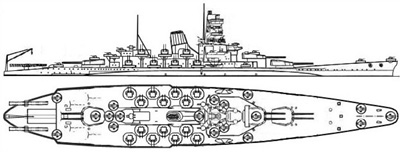
Aki 102(a)
I wasn't happy with the stern being so large and since I was going to
build her with a hull I had already built I changed the layout of the
plan view to mirror that of the hull I had built. Much sleeker looking
from above, she looked much 'cooler' and less 'pregnant' than the original
design. I also move the bridge back a few feet as B turret could have
never turned without making contact with the bridge. Float plane storage
was incorporated with a ramp leading under the main deck aft of X turret.
Total float plane complement could have been 5.
|
|
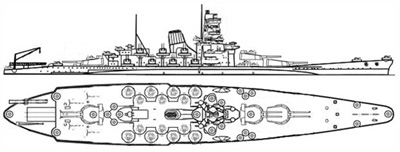
Aki 102(b)
Two things made me change the secondary suite:
1. the twin 3.9" was not
available in 1938 (although I figured she may have had them added eventually)
2. it was also a very small caliber for secondary armament.
Indeed the
Yamatos had been designed to carry the 6" in poorly armored turrets because
even the 5" gun was thought too small. The switch to the 5" DP gun was far
more realistic. I removed one catapult as they would not have been able to
operate properly with one another and the number of float planes the Aki
could carry was reduced to three due to the fact that I don't think four float
planes could had fit in the hangar aft of X turret. I also removed the second
deck that extended to the barbette of B turret to save top weight and give it a
more IJN appearance. I added more triple 25mm mounts throughout the deck.
|
|
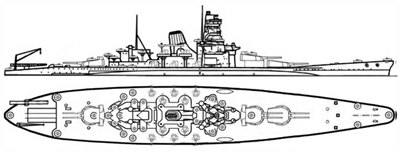
Aki 103(a)
Sure it would have been nice to have all those secondary guns, but it wasn't
a realistic layout and would have made the ship much more top heavy. The
range finders have been placed and I removed the outcropping amidships since
it looked bad. I had originally envisioned having the secondary guns placed
on the overhangs on the main deck, but the overhang was too far aft. With the
beam maxing out at nearly 100' I had more than enough room to place my secondary
suite within the confines of the hull. I removed the six triple 25mm mounts
sandwiching B turret as it didn't look operationally possible. I increased the
number of triple 25mm mounts around the aft superstructure, taking advantage of
the newly removed 5" DP mounts.
|
|
Aki 103(b)
Removing the four raised twin 5" mounts around the funnel and putting more
25mm mounts. I mean, the American battleships had 8 or 10 - 5" guns on board
and the Aki IS a pocket battleship after all… This would save on top weight
greatly and allow, at least, an additional 6 triple 25mm mounts. Hindsight
compels me to place several single 25mm mounts on the ship since they were
much more effective than the power mounts, but I must stick somewhat to what
the Japanese believed at the time. The only thing I have left to do is change the twin 5"
open mounts to the enclosed mounts.
|

|
Aki 104
After posting the Aki103(b) and asking for feedback the main concern was over horsepower
and the ships overall dimensions. At 609' x 98' she was rather "brickish". With a length
to width ratio of 6.2:1 she would have been very uneven. At first I had speculated that this
was due to the IJN wanting her small, but Adm Gurita noted to me that she would have been
inefficient for the task she was designed for and would have been a real fuel hound: "an
unacceptable design" knowing the IJN doctrine of the time. I was left with no option but to
extend her length and reduce her beam substantially. As noted before horsepower or SHP was
also a major problem. The IJN was unable to produce a ship that could place more than 40,000
SHP per shaft. So I lowered the SHP to a respectable level (160,000) and with the slimmer
design I feel that the ship could have produced AT LEAST 30 knots with this configuration.
The Aki 104 has a L:W ratio of 7.1:1
|

|
Specs for the Aki class of ship (101 to 103(b)):
Ships in class:
Aki, Mikawa
Dimensions:
Displacement: 26,273 tonnes (Standard)
LOA: 609'
Beam: 98'
Performance:
Horsepower: 200,000shp
Top Speed: 30.1 knots
Armament:
6 - 14" guns in twin mounts
12 - 5" DP in twin mounts
96 - 25mm AAW in triple mounts
Specs for the Aki class of ship (104):
Ships in class:
Aki, Mikawa
Dimensions:
Displacement: 26,000 tonnes (Standard)
LOA: 642'
Beam: 90'
Performance:
Horsepower: 160,000shp
Top Speed: 30 knots
Armament:
6 - 14" guns in twin mounts
12 - 5" DP in twin mounts
96 - 25mm AAW in triple mounts
So? What are your
thoughts on this "mini-monster"? Drop me an e-mail and let me know here
|